Reflections on a Profession
In 2003, Lewis gave a presentation at the Gertrude Gunn Forum in Indianapolis, IN, reflecting on her 50 years as an HIM professional. Lewis said that for her presentation, called “Reflections on a Profession,” she reviewed every issue of the Journal of AHIMA (which saw its own name evolve) for the years 1953, 1963, 1973, 1993, and 2003, to give an overview of the most significant changes in the industry during her full-time professional tenure.
This article, based on excerpts from Lewis’s presentation, highlights some of those changes. It reflects how HIM professionals have always had to learn new skills and master new technologies to secure their status in an evolving industry.

[caption id="attachment_15478" align="alignleft" width="300"]
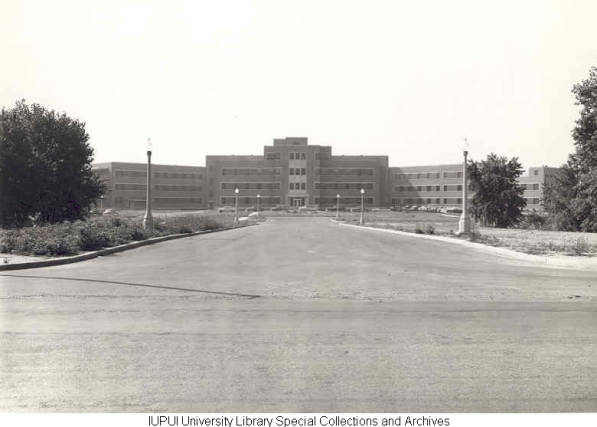
One of Lewis’s first jobs after college was working as a clerk at the Larue D. Carter Memorial Hospital, a short-term intensive care psychiatric facility. Lewis was the first person to be hired to the job with formal training in the medical records field. She was also the first person to notice that the facility’s medical records department didn’t send out discharge notifications. “I instituted an admission and discharge list and that simple thing gained me a lot of credibility. It also taught me that when introducing change in a new setting, begin with a project over which you have complete control and which you know will have a favorable outcome. Small successes not only give you credibility but also give the staff confidence that change is possible.”

[caption id="attachment_15480" align="alignleft" width="190"]
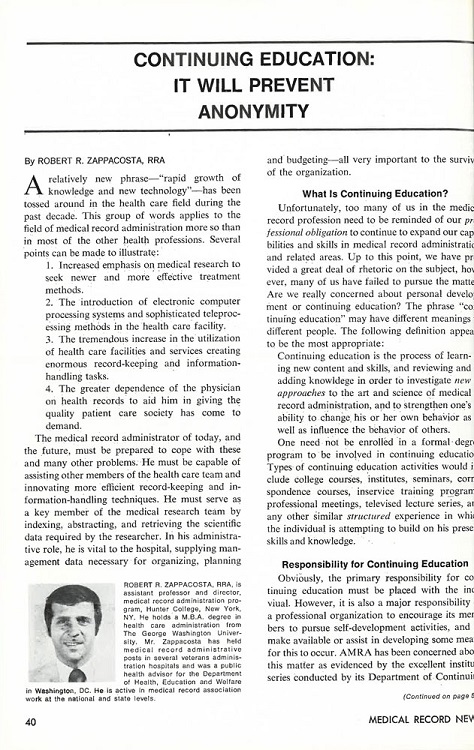
In 1973, the matter of continuing education was a hot topic. In an article Carol Lewis reviewed from a 1973 issue of Medical Record News (Journal of AHIMA), Robert Zappacosta, who served as the association’s president in 1979, defined continuing education as “the process of learning new content and skills, and reviewing and adding knowledge in order to investigate new approaches to the art and sciences of medical record administration and to strengthen one’s ability to change his or her own behavior as well as influence the behavior of others.” Zappacosta was worried that if medical records professionals didn’t advance their education, other professionals, such as physicians, would continue to be at the “leading edge” of the profession. He noted that physicians were responsible for developing “problem oriented medical records” instead of medical records professionals.
[caption id="attachment_15481" align="alignright" width="184"]
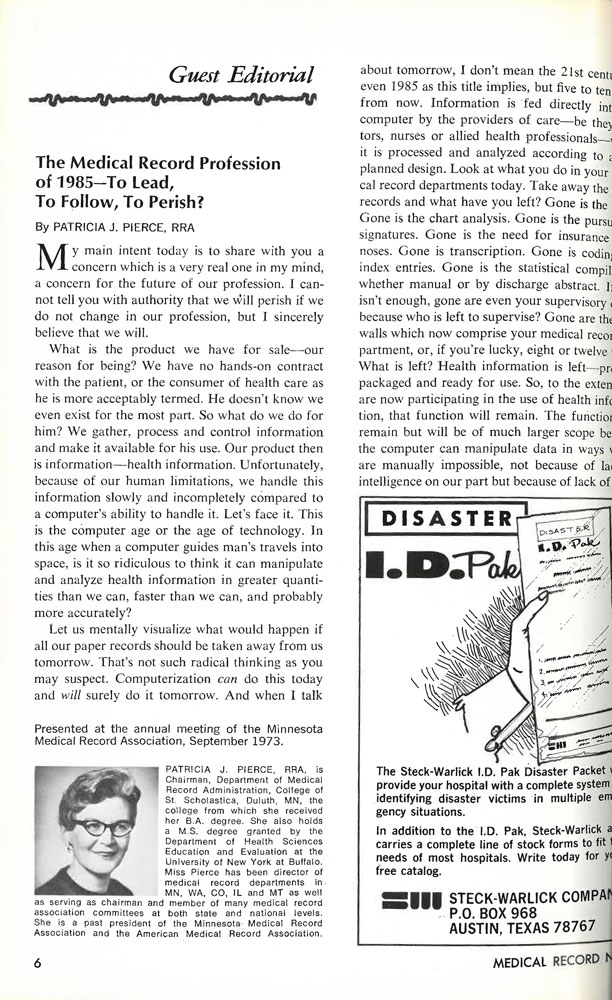
In a guest editorial of Medical Record News in 1973, Patricia Pierce imagined what would happen to the profession by 1985. Lewis writes that Pierce expressed her belief that unless the profession changed, it would perish. Action was needed, she argued, to prevent HIM doomsday in 1985. A task force was created in 1973, with a final report issued the following year, urging the association to consider the future of the RRA credential, and in the process, the task force concluded that the expanded role for the medical record administrator was that of the health information coordinator. They argued that this status would be achieved by completing a degree at the master’s or doctoral level with concentration in health information science, biostatistics-mathematics, education, or management science. This thinking is echoed today as the developers of HIM Reimagined encourage HIM professionals to continue furthering their education in line with trends towards informatics and data analytics.
[caption id="attachment_15483" align="alignright" width="300"]
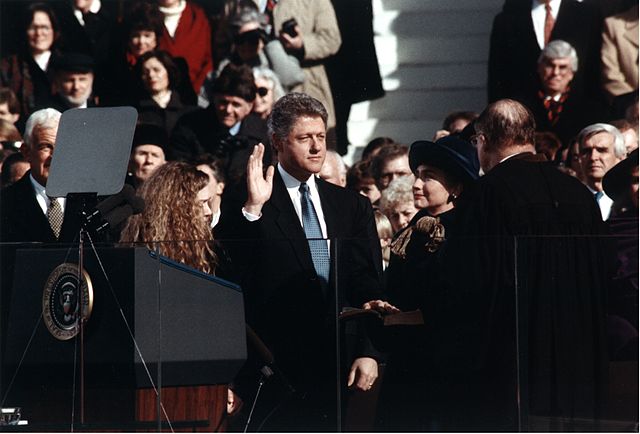
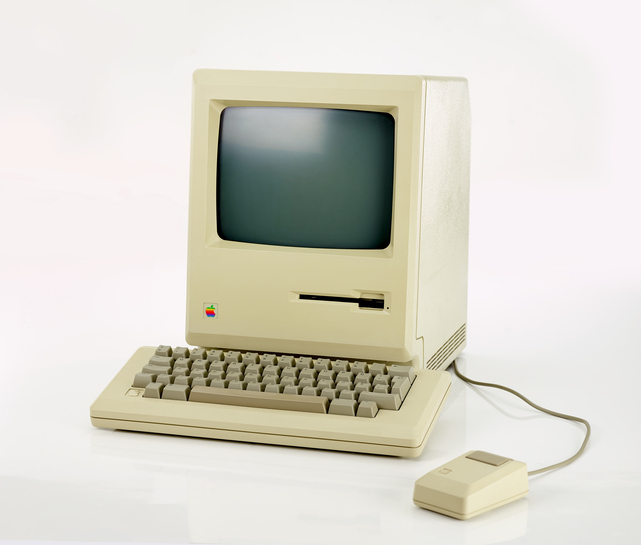
Lewis notes that “if 1983 was the year of the DRG, 1993 was the year of the CPR—computer-based patient record.” Bill Clinton was also inaugurated that year as President, and Lewis said that there was some excitement that his administration’s plan for a healthcare overhaul contained a requirement for electronic records for all inpatients. Although those reforms did not pass into law, articles about electronic records continued to generate interest, which may have contributed to the House of Delegates’ decision to change the association’s name from AMRA to the American Health Information Management Association (AHIMA).
By 2003, the last year included in Lewis’s presentation, she concluded that no educational program can offer all the knowledge and skills attained throughout one’s career. Rather, valuable lessons can be learned through life experiences, as well as continuing education and self-study. “What a program can do... is to show that it can be beneficial to question the status quo, to be open to new ideas and practices and, when they have demonstrated their worth, apply them enthusiastically.”